
AdsPower vs ClonBrowser: Which Anti-Detect Browser Wins?
Nov 18, 2026
Running multiple accounts on the same device without getting linked or banned is the daily reality for e-commerce sellers, affiliate marketers, social media managers, and web scrapers. Platforms like Amazon, Facebook, Google, and TikTok have become ruthless at detecting shared browser fingerprints—and a single slip can wipe out dozens of accounts. Anti-detect browsers solve this by giving every account its own isolated, unique digital identity.
In this comparison, we put three popular options side by side: AdsPower, Octo Browser, and Hidemyacc. Each has its own philosophy—AdsPower aims to be an all-in-one team platform, Octo Browser prioritizes raw fingerprinting precision and speed, and Hidemyacc focuses on simplicity and unlimited profiles. We’ve evaluated them on the criteria that matter most for daily multi-accounting, based on hands-on testing, community feedback, and available benchmark data.
AdsPower vs Octo vs Hidemyacc: Anti-Detect Browser Comparison product interface and feature overview.
Rather than rattling off feature lists, we looked at what actually determines success in the real world:

AdsPower vs Octo vs Hidemyacc: Anti-Detect Browser Comparison product interface and feature overview.
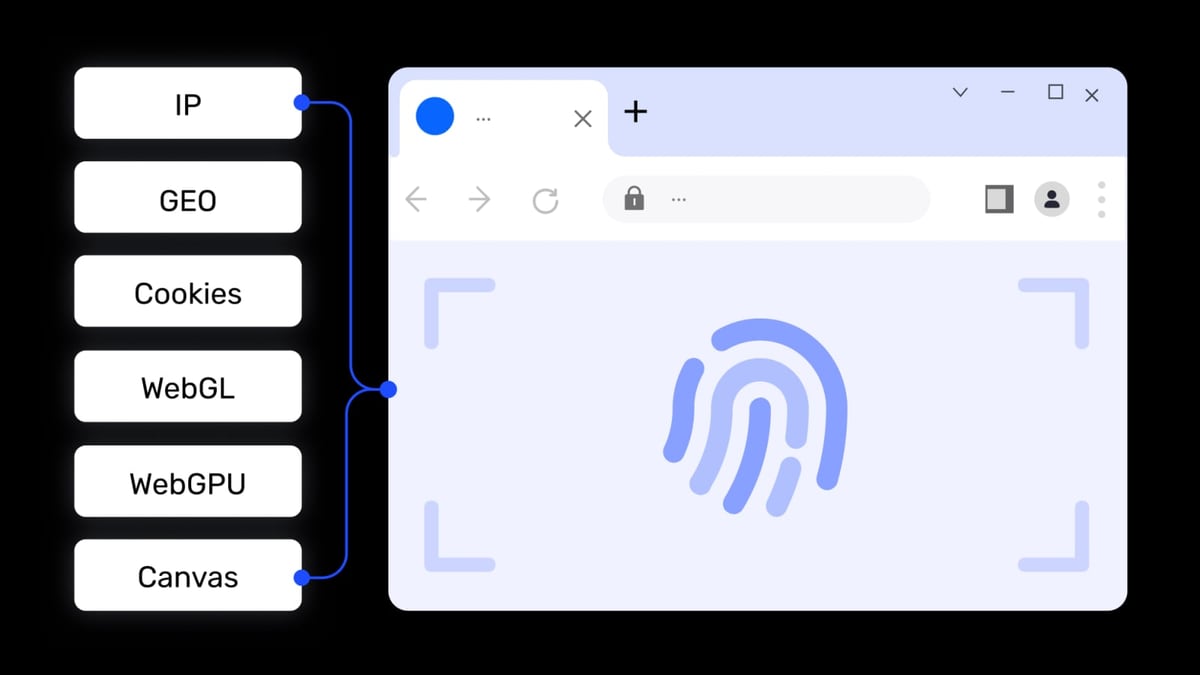
The entire game hinges on whether a browser can fool detection systems. All three browsers let you modify key parameters like Canvas, WebGL, AudioContext, fonts, and WebRTC, but they approach it differently.
Octo Browser gives you surgical control over every fingerprint variable. You can manually tweak individual parameters, mirror a specific device, or randomize everything. This level of granularity is a major advantage for users in high-risk niches like crypto arbitrage or scraping platforms with aggressive bot detection. The consistency of the spoofed fingerprints has been praised in several community reviews, and Octo Browser was named Best Anti-Detect Browser at the MAC Affiliate Conference 2024.
Hidemyacc stands out with its claim of unlimited customizable fingerprint parameters. The interface makes it easy to adjust screen resolution, installed fonts, hardware details, and more, aiming to generate profiles that score highly on fingerprint testing sites. For users who want a clean, test-passing browser identity without excessive manual configuration, Hidemyacc’s presets and unlimited profile creation are appealing.
AdsPower takes a different route. It supports both Chromium-based (SunBrowser) and Firefox-based (FlowerBrowser) kernels—a unique strength because some platforms behave differently or apply stricter checks on one engine. Combined with mobile device emulation for Android and iOS, AdsPower can match the User Agent to the underlying browser kernel more consistently. A 2024 research study by Arizona State University and Amazon confirmed AdsPower’s kernel-level consistency as a key factor in passing modern detection systems. This dual-kernel flexibility is a supported advantage for operations that need to blend in across diverse platform environments.
Winner? Precision control: Octo Browser. Unlimited parameter space: Hidemyacc. Kernel variety and mobile emulation: AdsPower.

AdsPower vs Octo vs Hidemyacc: Anti-Detect Browser Comparison product interface and feature overview.
If you’re running more than a few accounts—especially with colleagues—profile organization and permission controls become critical.
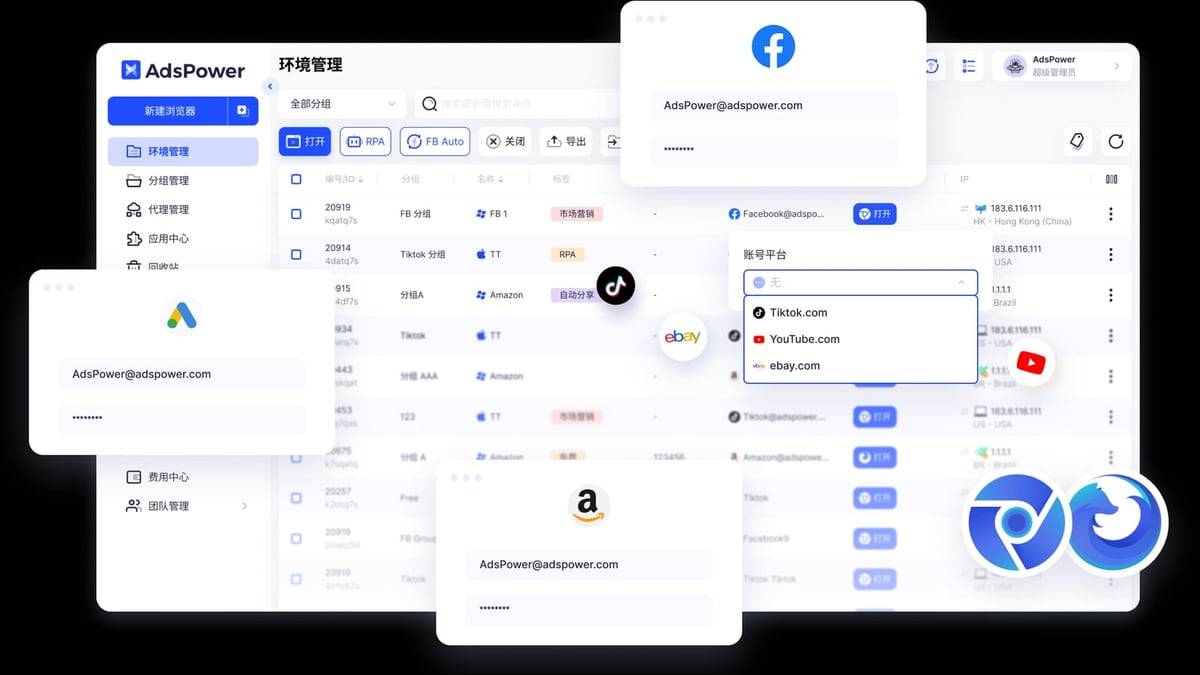
AdsPower dominates this category. It offers grouping, tagging, bulk creation, and bulk launch of profiles, plus a granular role-based permission system with operation logs that track every team member’s IP and actions. A standout feature is the Synchronizer, which mirrors actions across multiple profiles in real time—a massive productivity boost for account farming or gaming. For agencies and large e-commerce teams, these tools eliminate the chaos of spreadsheets and shared passwords.
Octo Browser supports basic team sharing, but its collaboration features are limited: no role-based permissions, no detailed activity logs, and no built-in synchronizer. It works well for a solo operator or a tiny team that just needs to exchange profiles occasionally.
Hidemyacc includes cloud sync for profiles and basic import/export, as well as team collaboration tools. However, it lacks the deep permission controls and bulk management workflows found in AdsPower. It’s sufficient for small groups that need to share access, but won’t satisfy a compliance-conscious enterprise.
If team scalability is non-negotiable, AdsPower has a clear, supported advantage. For solo operators, Octo’s lightweight structure or Hidemyacc’s simplicity may be all you need.
AdsPower vs Octo vs Hidemyacc: Anti-Detect Browser Comparison product interface and feature overview.
Repetitive tasks—cookie harvesting, friend requests, product listing updates—can be automated. Here’s how each browser handles that.
AdsPower offers a two-pronged automation strategy: a local API that’s compatible with Selenium, Puppeteer, Playwright, and even the MCP protocol for AI agent integration, and a built-in RPA (Robotic Process Automation) with pre-built templates and a drag-and-drop workflow creator. This means both non-technical users and developers can automate at scale. One template can warm up Facebook accounts or scrape Amazon listings without writing a single line of code.
Octo Browser caters to developers with direct support for Puppeteer and Playwright via its API. There is no built-in RPA or no-code tool, so you’ll need scripting skills to automate anything. This is perfect for tech teams who want to integrate Octo into a custom pipeline—if you’re comfortable writing code, you’ll appreciate the clean API. For more context on how these frameworks stack up, see our guide to browser automation frameworks.
Hidemyacc focuses on manual profile management and does not expose advanced automation APIs or RPA tools. Users who need to automate workflows would have to rely on external scripting and may face integration hurdles.
For mixed teams blending no-code and code, AdsPower’s combined RPA and API is the most flexible option currently.
All three browsers handle HTTP, HTTPS, and SOCKS5 proxies, but bulk management differs.
AdsPower supports bulk proxy assignment across profiles, proxy grouping, and environment-level proxy settings. The interface simplifies managing different IPs for hundreds of accounts, and a recent step-by-step guide on pairing AdsPower with NetNut proxies shows how easy integration can be.
Octo Browser makes individual proxy assignment seamless during profile creation, but lacks bulk assignment and bulk profile creation—a friction point when you’re spinning up 100 accounts simultaneously.
Hidemyacc includes proxy integration but does not emphasize bulk operations, making it less suitable for large-scale proxy switching.
For bulk proxy management, AdsPower’s toolset saves hours of manual work.
Octo Browser is noticeably lightweight. Profile launches are fast, and the RAM footprint stays low even with multiple profiles open. This makes it a top choice for users on less powerful machines or those who value speed above all.
AdsPower is a bit heavier due to its dual-kernel support and built-in automation tools. However, it remains stable when running many concurrent sessions—a trade-off where stability at scale is prioritized over raw launch speed.
Hidemyacc offers acceptable performance for moderate use. While not as sleek as Octo or as feature-packed as AdsPower, it handles daily multi-accounting without major slowdowns.
Cost can be the deciding factor.
For budget-conscious beginners or those wanting to test the waters, AdsPower’s free tier is the most accessible. You can also compare AdsPower with Hidemyacc and Indigo for a deeper pricing breakdown.
There’s no universal winner—your choice depends on your primary use case.
Yes, but it’s unnecessary. Each browser creates isolated profiles, so you only need one tool. Running multiple antidetect browsers simultaneously can lead to resource conflicts and fingerprint leaks.
AdsPower can emulate Android and iOS environments within the desktop browser, which helps manage mobile-only accounts. Octo Browser and Hidemyacc do not offer true mobile emulation, though you can pair them with separate cloud phone services for that purpose.
Generally, you can export cookies and credentials from one browser and import them into another, but fingerprints won’t transfer because each browser uses its own spoofing engine. It’s often better to start fresh to avoid detection anomalies.
No single tool excels at everything. The key is matching the browser to your scale, team size, and technical skill level. AdsPower regularly tests and updates multi-account tool comparisons to help you stay current.
AdsPower, Octo Browser, and Hidemyacc each earn their place in the antidetect landscape. Octo Browser impresses with its lean profile and high-end fingerprinting for technical users, Hidemyacc offers simplicity and generous customization options, and AdsPower delivers the most complete team and automation platform for scaling operations securely.
Your best bet is to map out your non-negotiables—team collaboration, automation, proxy bulk management, free tier—and run a trial. We’ve linked to hands-on setup guides throughout this article to give you a head start. Whatever you choose, a well-matched antidetect browser will save you from the headache of account bans and let you focus on growing your business.


