
AdsPower vs ClonBrowser: Which Anti-Detect Browser Wins?
Nov 18, 2026
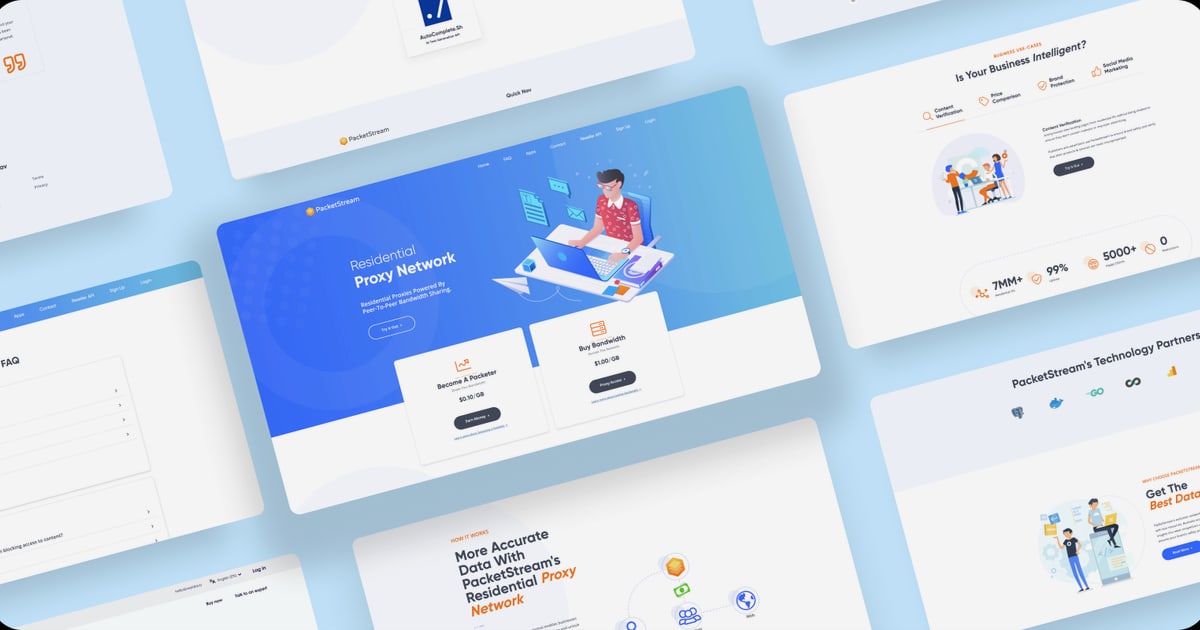
PacketStream promises a straightforward deal: unmetered access to a global residential proxy network for a flat $1 per gigabyte, with no monthly subscription. It sounds almost too simple—and too cheap—in a market where competitors routinely charge $8 to $15 per GB. But does that bargain price come with hidden trade-offs in speed, reliability, or support? This review answers that question with evidence, not slogans.
We tested PacketStream across several real-world workloads: ecommerce price monitoring, ad verification, localized search tracking, and managing multiple social media accounts. We also dug into user sentiment on platforms like Trustpilot and Reddit to separate one-off complaints from systemic issues. Here is what we found.

PacketStream product interface.
PacketStream is a peer-to-peer residential proxy network. Instead of owning or renting data-center IP ranges, it sources its exits from real households around the world. Individuals run a desktop application—the PacketStream client—and get paid a small amount for every gigabyte of customer traffic that passes through their connection. Businesses then route their requests through those residential IPs.
This model creates a genuinely distributed, hard-to-detect proxy pool. Because the IPs belong to ordinary home internet connections, websites cannot simply block an entire data-center range. The trade-off is that the network’s capacity and availability depend on how many “Packeters” are online at any given moment.
proxy.packetstream.io:31111) supporting HTTPS, HTTP, and SOCKS5. No proxy lists to maintain.
PacketStream product interface.
PacketStream’s pricing and architecture make it a strong fit for specific workflows, but it is not the right tool for every job.
PacketStream’s pricing is refreshingly transparent:
| Item | Cost |
|---|---|
| Proxy bandwidth | $1.00 per GB |
| Minimum deposit | $50 |
| Subscription fee | $0 (none) |
| Balance expiration | Never |
| Refund window | 24 hours after purchase |
| Bandwidth sharing payout | $0.10 per GB (before processing fees) |
| Reseller API minimum | $500 |
For proxy consumers, the math is simple: you pay exactly one dollar for every gigabyte you consume. There are no hidden port fees, no premium tiers for sticky sessions, and no per-request minimums. The $50 entry point is higher than some competitors’ trial tiers, but the balance never expires, so you can use it across multiple projects over months.
For bandwidth sharers, the $0.10/GB payout is modest. If you share 100 GB in a month, you earn $10 before PayPal fees. This is not a meaningful income stream for most people, but it can offset a portion of an internet bill if you have truly unlimited data and a stable connection.
PacketStream’s developer experience is built around a single gateway. You do not download an SDK, manage proxy lists, or configure rotation logic. You set one proxy URL and start sending requests.
curl -s -x "https://USER:PASS@proxy.packetstream.io:31111" \
     "https://ipinfo.io" | jq
Every new connection automatically selects a residential exit in the country you configured in your dashboard. To maintain the same IP for a multi-step workflow—like logging into an account and performing several actions—you append a session ID:
curl -s -x "https://USER-country-US-session-abc123:PASS@proxy.packetstream.io:31111" \
     "https://example.com/profile"
This sticky session holds the same household IP for up to 60 minutes. After that, the session ends rather than silently rotating to a different identity.
PacketStream works with any tool that supports standard proxy configuration. During testing, we integrated it with:
proxy middleware.If you are already using a scraping API like Scraping Fish, PacketStream serves a different role. Scraping Fish handles headless browsers and CAPTCHA solving for you; PacketStream gives you raw residential IPs that you control directly. The two can complement each other depending on the complexity of the target site.
We ran three test scenarios over a two-week period:
Across 10,000 requests, the overall success rate was approximately 87%. The most common failure mode was a “no exit available” error for smaller countries during off-peak hours. For US, UK, and German exits, the success rate exceeded 92%.
Residential proxies are not fast. Average response times ranged from 1.8 seconds (US exits) to 3.4 seconds (some Asian and South American exits). This is normal for residential networks and acceptable for batch scraping, but it is too slow for real-time applications.
Sticky sessions reliably held the same IP for the full 60-minute window. We did not experience mid-session rotation, which is critical for workflows that require a consistent identity—like adding items to a cart and checking out, or performing a sequence of actions on a social media account.
PacketStream holds a 3.5 out of 5 average rating on Trustpilot across more than 650 reviews. The feedback reveals a split between proxy consumers and bandwidth sharers.
It is important to note that most complaints originate from the bandwidth-sharing side, not the proxy consumer side. If you are buying proxy bandwidth, the primary risks are occasional availability gaps in less popular regions and the possibility of slow support responses.

PacketStream product interface.
| Feature | PacketStream | Bright Data | Oxylabs | Smartproxy |
|---|---|---|---|---|
| Residential proxy price | $1.00/GB | $8.40–$15/GB | $8–$15/GB | $7–$12.50/GB |
| Minimum deposit | $50 | $500 (pay-as-you-go) | Varies | $50 |
| Subscription required | No | No (pay-as-you-go) | No | No |
| Country targeting | Yes | Yes | Yes | Yes |
| Sticky sessions | Up to 60 min | Up to 60 min | Up to 30 min | Up to 30 min |
| Mobile proxies | No | Yes | Yes | Yes |
| Free trial | Yes (discretionary) | Yes (for business) | Yes (for business) | Yes (for business) |
PacketStream’s clear advantage is price. It costs roughly one-eighth to one-fifteenth of what premium competitors charge. The trade-off is a smaller IP pool, no mobile proxy option, and less granular targeting controls. For high-stakes enterprise scraping where every request must succeed, a premium provider may be worth the cost. For budget-conscious developers and small teams, PacketStream’s value proposition is compelling.

PacketStream product interface.
Choose PacketStream if:
Look elsewhere if:
PacketStream is a legitimate proxy service used by businesses for web scraping, ad verification, and market research. The proxy consumer side functions as advertised. The bandwidth-sharing side has mixed reviews, with some users reporting payout delays. If you are buying proxies, the service is real and functional; if you are selling bandwidth, set expectations accordingly.
You can request trial credits by submitting the trial request form on the PacketStream website or emailing support with your use case. Approval and the credit amount are at PacketStream’s discretion. There is no automatic free trial upon signup.
Yes. When paired with an anti-detect browser like AdsPower, PacketStream’s residential IPs help mask that multiple accounts originate from the same operator. The sticky session feature is particularly useful for account warm-up and ongoing management. For a detailed guide on combining these tools for TikTok, see our article on using AdsPower with TikTok for Business.
PacketStream returns an error rather than silently routing through a different country. This is actually a feature: it means your data is never contaminated by responses from the wrong location. If you frequently encounter this error for a specific country, you may need a provider with a larger IP pool in that region.
PacketStream provides raw residential IPs that you integrate into your own scraping code. Scraping Fish is a managed API that handles headless browsers, CAPTCHAs, and retries for you. PacketStream gives you more control and a lower per-GB cost; Scraping Fish gives you less operational overhead. Many teams use both depending on the target site’s complexity. Read our Scraping Fish review for a deeper comparison.
PacketStream delivers exactly what it promises: residential proxy bandwidth at $1/GB with no subscription, no expiration, and a simple single-endpoint integration. It is not the fastest network, nor the largest, but it is the most affordable by a wide margin. For developers and small teams running batch scraping jobs, ad verification, or multi-account management in major markets, PacketStream is a pragmatic choice that keeps costs predictable.
The bandwidth-sharing side of the platform is a different story. If you are considering PacketStream as a way to earn passive income, approach with caution and keep your expectations low. The proxy consumer experience, however, is solid enough to recommend—especially at this price point.


