
AdsPower vs ClonBrowser: Which Anti-Detect Browser Wins?
Nov 18, 2026
If you've ever tried to extract data from a modern website, you know the pain: IP bans, CAPTCHA walls, and JavaScript-rendered content that returns nothing but an empty HTML shell. Building your own scraping infrastructure to handle these problems is expensive and time-consuming.
Scrapestack promises to solve all of that with a single REST API call. But does it deliver? In this review, we'll break down exactly what Scrapestack offers, who should use it, where it falls short, and how it compares to other options on the market.
Scrapestack Review 2026: Pricing, Features & Use Cases - supporting product research image 1.
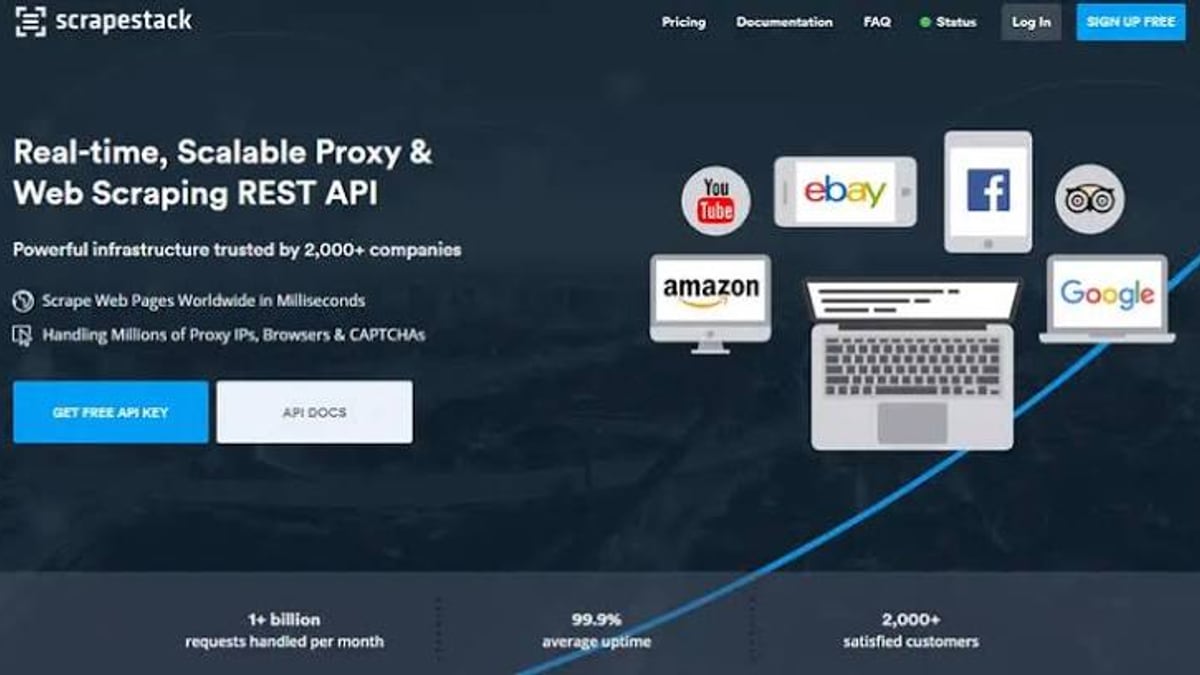
Scrapestack is a real-time web scraping REST API maintained by apilayer, a company based in London and Vienna known for its API-as-a-service products. The service handles the heavy lifting of web scraping: proxy rotation, CAPTCHA solving, JavaScript rendering, and geo-targeting — all through a single endpoint.
Instead of managing your own pool of proxies, headless browsers, and retry logic, you send a URL to Scrapestack and receive the rendered HTML back. The infrastructure behind it processes over 1 billion requests per month with 99.9% uptime and is trusted by 2,000+ companies.
Scrapestack Review 2026: Pricing, Features & Use Cases - supporting product research image 2.
The core interaction is simple: an HTTP GET request to the Scrapestack API endpoint with your target URL and API key.
GET https://api.scrapestack.com/scrape
  ?access_key=YOUR_API_KEY
  &url=https://example.com
Behind the scenes, Scrapestack:
You get back the full HTML of the page — exactly what a real user would see in their browser.
Scrapestack maintains a pool of over 35 million IP addresses spanning datacenter and residential proxies across dozens of global ISPs. Every request can go through a different IP, making it difficult for target websites to detect and block scraping activity.
Building this infrastructure yourself would cost thousands per month in proxy subscriptions alone.
Modern websites built with React, Angular, or Vue render content client-side. A standard HTTP request returns a skeleton page with no useful data. Scrapestack runs a full headless Chrome browser on each request when needed, executing JavaScript and returning the final rendered DOM.
This feature is essential for scraping e-commerce sites, social media platforms, news portals, and SaaS dashboards.
CAPTCHAs are one of the biggest blockers in web scraping. Scrapestack integrates automated CAPTCHA solving for Google reCAPTCHA, hCaptcha, and other challenge systems. This happens invisibly — no additional configuration required.
Need to see content that's only visible in Germany, Japan, or the US? Scrapestack lets you specify the country of origin for your requests with a single parameter. This is valuable for market research, price comparison, localization testing, and competitive intelligence.
Scrapestack works with any programming language that can make an HTTP request: Python, Node.js, PHP, Ruby, Go, Java, and more. The API documentation includes working code examples, and integration typically takes under 15 minutes for experienced developers.
The service handles over 1 billion requests per month with 99.9% uptime. Whether you're scraping 1,000 pages for a side project or 10 million for enterprise data pipelines, the infrastructure scales without degradation.
Scrapestack offers a free plan and several paid tiers:
| Plan | Price | Requests/Month | Key Features |
|---|---|---|---|
| Free | $0 | 100 | Standard proxies, HTTPS, concurrent requests, JS rendering, 100+ locations |
| Basic | $19.99/mo | 50,000 | All free features + premium proxies, priority support |
| Professional | $79.99/mo | 500,000 | Higher request limits, advanced features |
| Enterprise | Custom | Custom | Dedicated infrastructure, SLA, custom integrations |
The free plan requires no credit card and is ideal for testing. Annual billing discounts are available.
Compared to competitors like ScrapingBee, Scrapestack's pricing is competitive for mid-volume users. The Basic plan at $19.99 offers 50,000 requests, while ScrapingBee's similar tier starts at $49 for 100,000 requests.
Scrapestack Review 2026: Pricing, Features & Use Cases - supporting product research image 3.
Scrapestack can extract product prices, availability, and descriptions from competitor websites. The JavaScript rendering ensures you get dynamically loaded content, while IP rotation prevents blocks during frequent checks.
Extract contact information, business listings, and company data from directories and review sites. Geo-targeting lets you focus on specific markets.
Collect articles, headlines, and metadata from news sites. The CAPTCHA handling ensures you don't get stuck behind challenge pages.
Track keyword rankings, meta descriptions, and SERP features across different locations. Geo-targeting is particularly useful for local SEO analysis.
curl "https://api.scrapestack.com/scrape?access_key=YOUR_KEY&url=https://example.com"
render_js=1 parameter:curl "https://api.scrapestack.com/scrape?access_key=YOUR_KEY&url=https://example.com&render_js=1"
Add geo-targeting with the country parameter (use country codes like us, de, jp)
Integrate into your code — here's a Python example:
import requests

response = requests.get('https://api.scrapestack.com/scrape', params={
    'access_key': 'YOUR_API_KEY',
    'url': 'https://example.com',
    'render_js': '1'
})

html = response.text
print(html)
For more advanced scraping setups, you might combine Scrapestack with anti-detect browsers like AdsPower for session management, or use Beautiful Soup for parsing the returned HTML.
Scrapestack Review 2026: Pricing, Features & Use Cases - supporting product research image 4.
| Feature | Scrapestack | ScrapingBee | Bright Data |
|---|---|---|---|
| Starting Price | $19.99/mo | $49/mo | Custom |
| Free Tier | 100 req/mo | 1,000 req/mo | No |
| JS Rendering | Yes | Yes | Yes |
| CAPTCHA Solving | Yes | Yes | Yes |
| Residential Proxies | Yes | Yes | Yes |
| Built-in Parsing | No | No | No |
| API Type | REST | REST | REST |
Scrapestack is a solid middle-ground option — more affordable than enterprise solutions like Bright Data but with fewer features than some mid-range competitors. Its strength lies in simplicity and reliability rather than advanced functionality.
Yes, Scrapestack offers a free plan with 100 requests per month. No credit card is required to sign up.
Yes. Add the render_js=1 parameter to your request, and Scrapestack will use a headless Chrome browser to render JavaScript before returning the HTML.
Yes. Scrapestack includes automated CAPTCHA solving that works with Google reCAPTCHA, hCaptcha, and other common challenge systems.
Any language that can make HTTP requests: Python, JavaScript/Node.js, PHP, Ruby, Go, Java, C#, and more.
Scrapestack saves significant time and money if you need proxy rotation, CAPTCHA solving, and JS rendering. For simple scraping tasks on static websites, building your own solution with requests + Beautiful Soup may be cheaper.
Web scraping legality depends on your use case and jurisdiction. Always review a website's terms of service and robots.txt before scraping. Scrapestack itself is a tool — how you use it determines legality.
Scrapestack is a reliable, easy-to-integrate web scraping API that solves the most painful parts of data extraction: proxy management, CAPTCHA handling, and JavaScript rendering. It's an excellent choice for developers who want to start scraping quickly without building complex infrastructure.
The free plan is generous enough for testing, and paid plans are reasonably priced for small to medium volumes. For high-volume enterprise needs, you may want to evaluate dedicated proxy services or enterprise scraping platforms.
If you're looking for a straightforward API that just works — and you're willing to handle HTML parsing yourself — Scrapestack is a strong contender in the 2026 web scraping landscape.
Note: AdsPower helps teams compare and select the best tools for data extraction and automation workflows.


