
AdsPower vs ClonBrowser: Which Anti-Detect Browser Wins?
Nov 18, 2026
If you manage multiple accounts for e-commerce, affiliate marketing, social media, or scraping, you already know the pain: one shared browser fingerprint can link your accounts and trigger bans. Antidetect browsers and cloud phone platforms solve this by giving each account its own isolated, believable device identity. But with dozens of tools claiming to be "undetectable," how do you choose?
This ranking is based on independent testing and verified specifications from published reviews, vendor documentation, and hands-on fingerprint checks. We scored each product on fingerprint consistency, mobile and cloud support, automation capabilities, team features, and real pricing at scale. We excluded tools that are not true antidetect browsers (like session managers) and those that have shut down. AdsPower is not ranked here because it is a well-known adjacent tool, but we mention it where it fits a complementary workflow.
First viewport screenshot of Antidetect Browser & Cloud Phone Industry Insights about Multi-accounting | MostLogin.
We weighted five factors:
We verified prices and free-tier limits as of mid-2026. Antidetect tools change quickly, so always confirm details on the vendor's site before committing.
First viewport screenshot of Antidetect Browser & Cloud Phone for Multi-accounting | MostLogin.
Multilogin has been the reference point for premium antidetect browsing for years. It ships two engines: Mimic (Chromium-based) and Stealthfox (Firefox-based), and it offers a separate Cloud Phones product that runs real Android devices. In independent tests, a default Multilogin profile passed Pixelscan, Iphey, and CreepJS cleanly, with CreepJS reading a genuine Apple GPU at high confidence. That level of consistency is why agencies and high-value account operators choose it.
Platforms: Windows, macOS, Linux (desktop client only). Cloud phones run Android.
Automation: Local and remote API, official Selenium, Puppeteer, and Playwright docs, CLI, and Python. API is rate-limited on entry tiers.
Pricing: No free tier; a $2 three-day trial is available. Paid starts at $11/month for 10 profiles (monthly billing), or about $7/month annually. Team seats start at the Pro 100 tier ($40/month).
Best for: Teams that need the strongest fingerprint quality and are willing to pay for it.
Not ideal for: Budget users or those who need a free plan to test.
GoLogin is one of the few antidetect browsers with a native Android app, making it a strong choice if you need to manage accounts on mobile devices as well as desktops. It runs on Orbita, its own Chromium fork, and offers a cloud browser and cloud Android product for paid plans. Its free tier includes 3 profiles with no time limit (no API or team features).
Platforms: Windows, macOS, Linux, Android (native app), plus cloud browser and cloud Android.
Automation: REST API (300–1,200 requests per minute on paid plans), Selenium and Puppeteer guides, and a Browser MCP for AI agents.
Pricing: Free for 3 profiles. Paid starts at $9/month for 10 profiles (monthly), or about $4.50/month annually. Enterprise pricing at $179/month for 1,000 profiles.
Best for: Individuals and small teams who want a balance of price, platform coverage, and a genuine free tier.
Not ideal for: Users who need a Firefox-based engine or advanced team controls on the free plan.
GeeLark specializes in cloud phones—real Android devices hosted in the cloud, not emulators. This makes it ideal for managing mobile apps like TikTok, Instagram, and WhatsApp at scale without tying up physical phones. It also offers a desktop antidetect browser for cross-platform workflows. In tests, GeeLark's cloud phones passed fingerprint checks and felt responsive.
Platforms: Windows, macOS, Linux (desktop browser) plus cloud Android phones.
Automation: API and RPA tools for automating app interactions.
Pricing: Starts around $5/month plus usage fees. Free tier includes 2 phones for 30 minutes.
Best for: Social media marketers and app testers who need real mobile environments.
Not ideal for: Users who only need desktop browser profiles.
Kameleo sells by concurrent running browsers rather than stored profiles, which suits scraping workloads where you run many profiles but only a few at a time. It offers two engines (Chroma and Junglefox) and includes a Local API on every plan, even the free one. Its free tier allows 2 running browsers with a 300-minute allowance.
Platforms: Windows, macOS; Linux via Docker.
Automation: Local API on all plans, plus Selenium, Puppeteer, and Playwright support.
Pricing: Free tier with 2 running browsers and 300 minutes. Startup plan at €59/month for 10 running browsers.
Best for: Developers who automate heavily and want API access without paying upfront.
Not ideal for: Non-technical teams that open many profiles manually.
Octo Browser uses its own Chromium fork, Octium, and prices for volume. It has no free plan, but its Base tier at €79/month includes 200 profiles and API access, making it cost-effective for operations running thousands of profiles. Seats are included in the tier price, which is rare.
Platforms: Windows, macOS, Linux, iOS app.
Automation: Local API from the Base plan; Selenium and Puppeteer support.
Pricing: Lite at €10/month for 3 profiles; Base at €79/month for 200 profiles; Advanced at €329/month with a very high profile limit.
Best for: Large-scale operations that need many profiles on one subscription.
Not ideal for: Anyone who wants to test before paying, as there is no free tier.
Dolphin Anty is popular among media buying teams and has a scenario builder for automation. Its free plan includes 5 profiles for 1 user (no API). The Starter plan at $10/month covers up to 60 profiles, which is generous for small teams. Extra users cost $10–$25/month each.
Platforms: Windows, macOS, Linux.
Automation: Scenario builder; API on paid plans.
Pricing: Free for 5 profiles. Starter at $10/month for up to 60 profiles. Base at $89/month for 100 profiles.
Best for: Media buying teams that already use Dolphin's ad tools.
Not ideal for: Growing teams, because seats are billed per user and can add up.
Undetectable.io separates cloud profiles from local profiles. Its free plan includes 5 cloud profiles for 1 user (no API), and unlimited local storage is a paid feature. Yearly plans advertise monthly equivalents of $34 for Base (50 cloud profiles) and $69 for Professional (100 cloud profiles).
Platforms: Windows, macOS.
Automation: Local API on paid plans; Selenium, Puppeteer, Playwright support.
Pricing: Free for 5 cloud profiles. Paid from ~$34/month (annual billing) for 50 cloud profiles.
Best for: Solo users who are fine with profiles stored on one computer.
Not ideal for: Teams, because extra seats cost $15–$20/month each, and no Linux support.
MoreLogin combines antidetect browser profiles with a separate cloud phone product. Its free plan includes 2 profiles and 2 users, and notably includes the Local API—unusual for a free tier. Pro lists at $9/month for 10 profiles with unlimited team members. Large profile counts require a custom quote.
Platforms: Windows, macOS, Linux; separate cloud phone product.
Automation: Local API, RPA, Selenium, Puppeteer, Playwright.
Pricing: Free for 2 profiles and 2 users. Pro at $9/month for 10 profiles. Custom for larger needs.
Best for: Developers who want to test an API before paying, and small teams on a budget.
Not ideal for: Buyers who want transparent pricing at 100 or 1,000 profiles.
Incogniton is a straightforward Chromium-based profile manager for Windows and macOS. New users get 10 profiles for 2 months, after which the account drops to 3 free profiles. Starter Plus costs $19.99/month for 10 profiles, and Professional costs $79.99/month for 150 profiles and 3 seats (or $55.99/month billed every six months).
Platforms: Windows, macOS.
Automation: REST API from the Entrepreneur plan; Selenium and Puppeteer support.
Pricing: Free for 3 profiles after trial. Starter Plus at $19.99/month for 10 profiles. Professional at $79.99/month for 150 profiles.
Best for: Beginners who want a simple interface and fewer than 10 profiles.
Not ideal for: Linux users or those who need automation on low-cost plans.
MostLogin is an antidetect browser and cloud phone platform designed for secure multi-accounting and digital identity management. It lets you create unique browser profiles with isolated fingerprints, manage multiple accounts on a single device, and run Android apps in the cloud. Its unified dashboard and team collaboration features—shared profiles and role-based access—make it suitable for distributed teams. A free tier offers 5 profiles and a Windows download.
Platforms: Windows (desktop browser) plus cloud Android phones.
Automation: Not heavily documented in public sources, but the platform supports scalable account operations.
Pricing: Free for 5 profiles. Paid plans available; check the official site for current pricing.
Best for: Affiliate marketers, e-commerce sellers, social media managers, and teams that need both browser and cloud phone capabilities in one tool.
Not ideal for: Users who need extensive third-party automation integrations or Linux support.
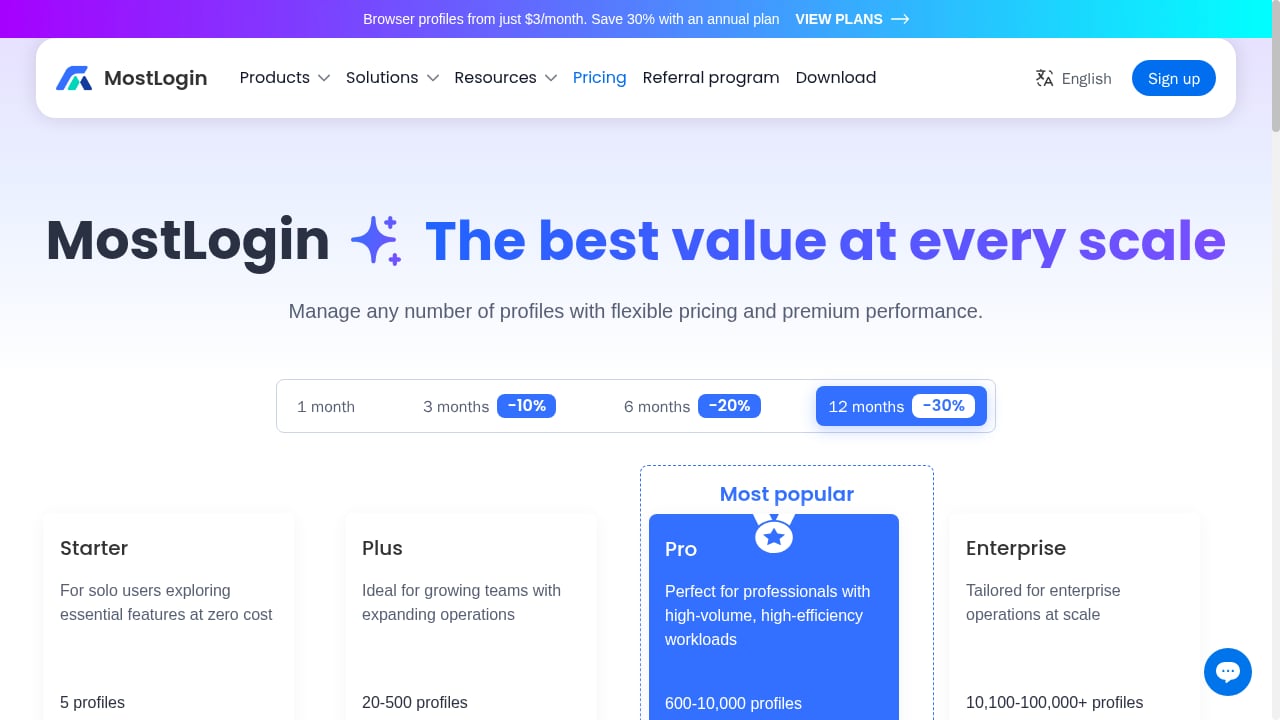
First viewport screenshot of Antidetect Browser & Cloud Phone Pricing | MostLogin.
For a deeper comparison of specific tools, see our AdsPower vs BitBrowser vs Dolphin Anty guide and our AdsPower vs Hidemyacc breakdown. If you are managing FBA operations, our FBA fulfillment explained article covers how multi-account sellers handle logistics safely.
An antidetect browser creates isolated browser profiles with unique fingerprints to manage multiple web accounts on a desktop. A cloud phone runs a real Android environment in the cloud, letting you manage mobile apps without physical devices. Some platforms, like MostLogin and GeeLark, offer both.
Yes, antidetect browsers are legal in most countries. They are used for legitimate purposes like managing multiple e-commerce stores, running affiliate campaigns, and testing websites. However, using them to violate a platform's terms of service can get your accounts banned.
Start with the number of accounts you actively manage. Most free tiers offer 2–5 profiles, which is enough to test. Paid plans scale from 10 to thousands of profiles. Choose a tool that lets you upgrade without changing platforms.
Free plans are good for testing, but they often lack API access, team features, and enough profiles for real operations. For serious multi-accounting, a paid plan with reliable fingerprinting and automation is worth the investment.
Some do. GoLogin has a native Android app. Others, like Multilogin and GeeLark, offer cloud phones that run Android in the cloud, accessible from any device. MostLogin also provides a cloud phone solution.
The best antidetect browser or cloud phone platform for you depends on your specific needs: fingerprint quality, mobile support, automation, team collaboration, and budget. Multilogin leads for high-stakes fingerprinting, GoLogin offers the best all-round value with a free tier, and GeeLark excels at real cloud phones. MostLogin stands out for teams that want both browser and cloud phone capabilities in one integrated platform. Evaluate your workflow, test the free tiers, and choose the tool that scales with your account operations.
For more detailed comparisons, see our Top 10 Antidetect Browser & Cloud Phone Software 2026 ranking and our Genlogin review. If you use AdsPower alongside these tools, our guide to using AdsPower with proxies can help you optimize your setup.


